A Natural Language Processing Analysis of Zuckerberg’s 2017 Essay ‘Building Global Community’
Background: Mark Zuckerberg’s 2017 essay “Building Global Community,” is a 6,000 word mission statement that reads like a corporate manifesto. For a project in a Data Mining class, I found it interesting to analyze the essay with a basic sentiment analysis algorithm. The essay has a relatively simple framework; for each category Zuckerberg discusses a category of societal issues and then describes the way in which Facebook is changing its infrastructure to combat them.
Process: I used Natural Language Toolkit’s (NLTK) sentiment analysis tool Sentiment Vader, which measures the positivity and negativity of a given word, marking them on an index from -1 to 1. First, I used NLTK to tokenize the essay text file. Next, I applied the Sentiment Vader on every sentence in the file. Then I used the graphing plugin plotly to plot the sentiment for every sentence.
My initial results were pretty disappointing. The x-axis represents the sentence index, the y-axis the sentiment value for each sentence (ranging from -1 to 1).
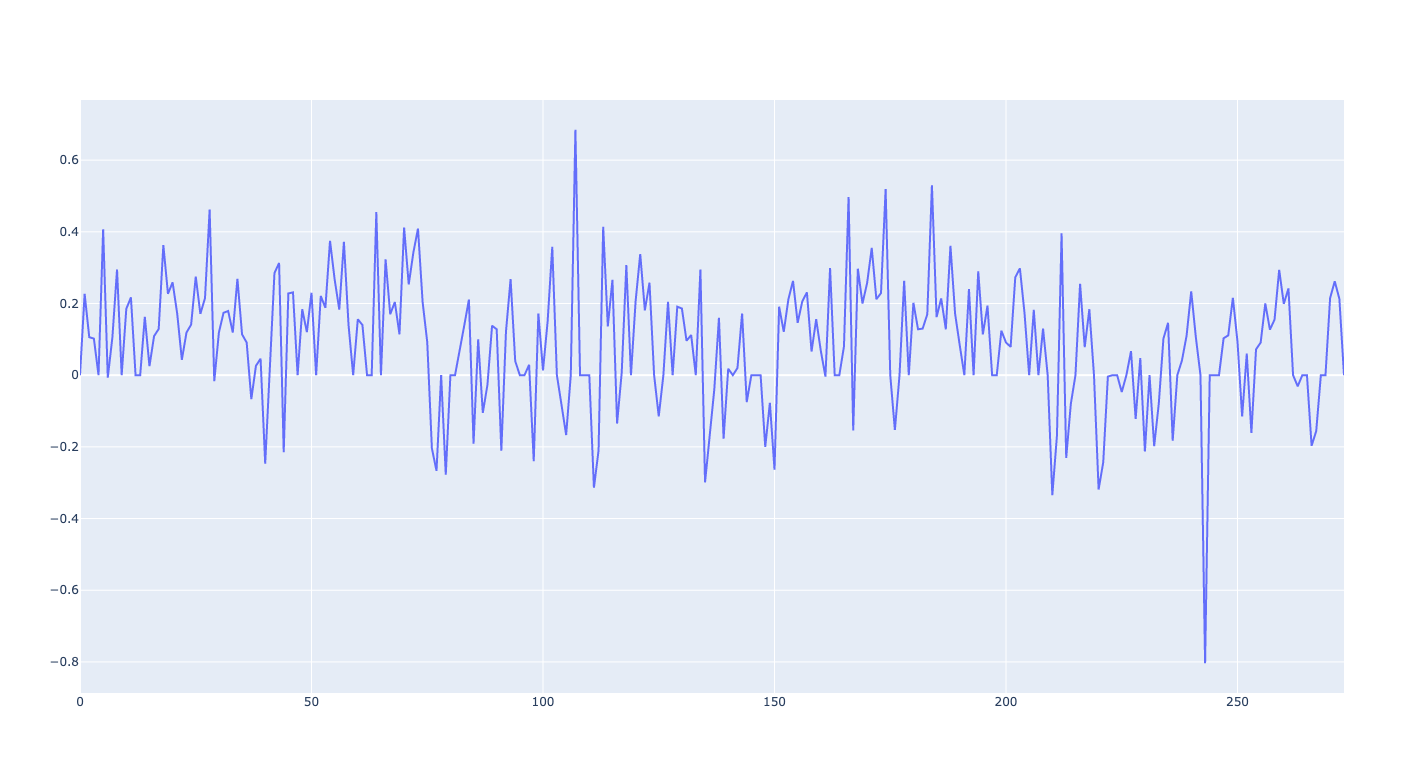
Improvement: In order to deal with the high variance in the data, I plotted a 10-increment moving average of the sentence sentiments. I also marked the headers of each section. Each header in the essay is marked in the sequence of sentences.
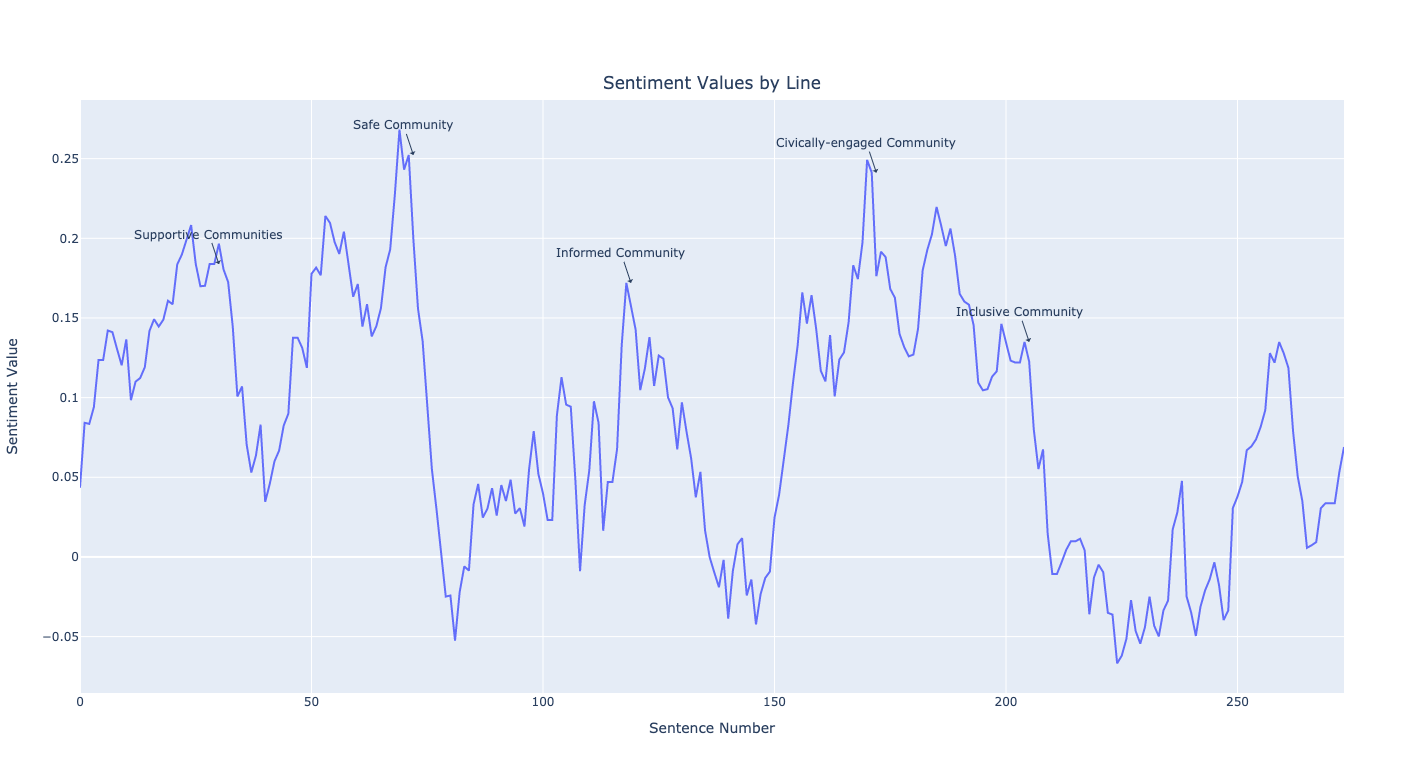
Summary: The result was a much more comprehensible graph, uncovering several interesting observations.
- At the beginning of almost every section, the sentiment drops considerably then shoots up up until the next section. This mirrors the semantic content of the essay, in which every section begins with a description of some unsolved problem, followed by Facebook’s proposed response. By repeatedly establishing negativity, Zuckerberg stresses the imperative of Facebook’s mission.
- The most drastic dip belongs to “Safe Community,” indicating that there are lower Sentiment Vader positivity scores for the topics addressed in the section. Some of those topics are “Suicide,” “Terrorism,” and “Climate Change.”
- The sections “Supportive Communities” and “Informed Communities” end in a sentiment score higher than they began with. This might be attributable to Facebook’s analysis that the perceived upside of those goals outweighs the perceived downside. In other words, “Safety” might end at a lower benchmark because once the worlds is safe it can’t be more safe, yet an informed world can (arguably) always be more informed.
- The sentiment of the essay largely remains positive. Zuckerberg isn’t too much of a downer.
 Hi I'm Nick